Collaboreat
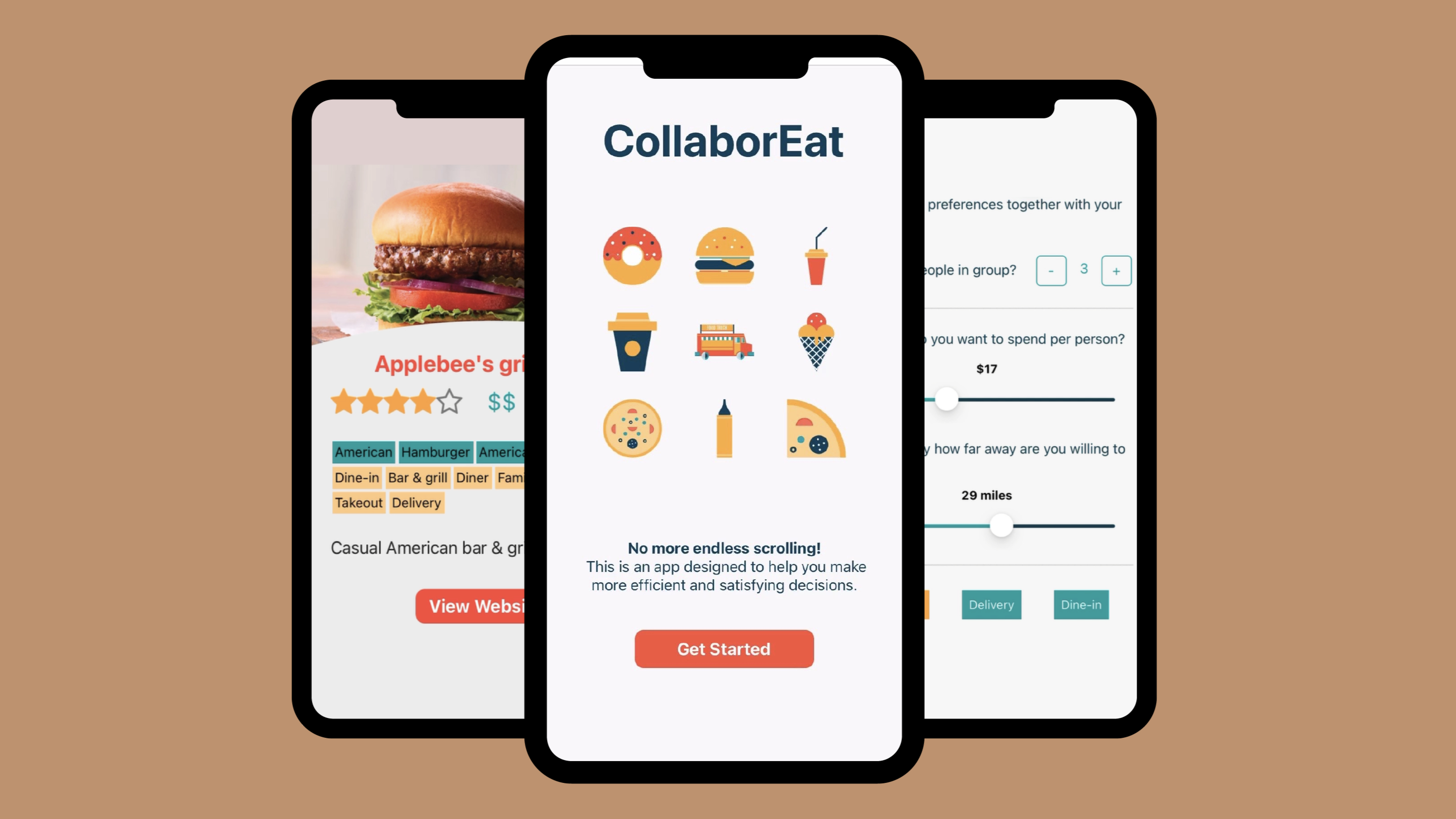
A mobile app that helps groups decide where to eat by reducing choice overload and helping them reach a fair decision faster.
Technologies Used
You’re in a new place with a group, trying to decide where to eat. Everyone has different preferences, and what should be simple turns into endless scrolling and conflicting opinions. Platforms like Yelp and Google Reviews are designed to maximize engagement, not help you decide. They rank by popularity and ratings, introducing bias and offering no meaningful way for groups to collaboratively narrow choices down together.
As part of a grant-funded research project at Lehigh University, we designed and built a mobile app in React Native and Firebase around three core systems: a group preference form to capture needs like budget, distance, and dietary restrictions; a fuzzy logic filtering algorithm to reduce popularity and review bias by scoring restaurants against the group's stated preferences rather than crowd-sourced rankings; and a pass-the-phone anonymous voting flow where each member independently weighs in on the shortlist, guiding the group toward a decision that balances individual preferences with overall satisfaction.
Demo of the Collaboreat app, showing the group preference form, fuzzy logic filtering, and anonymous voting flow.
We conducted IRB-reviewed user testing with 30 groups across seven iterations of the app, which demonstrated measurable improvements in both decision time and user satisfaction with each version.
207
Restaurants
Bethlehem, PA case study dataset
30
Groups tested
Families of 2–5 participants touring Lehigh University.
7
App iterations
Design evolved from early drag-and-drop ranking to a faster interest-score model.
Findings were presented at the Lehigh CAS Research Symposium, demonstrating how recommendation systems can reduce bias and better support real-world group decision making.
Collaboreat research poster presented at the Lehigh University 2022 Undergraduate Research Symposium.